

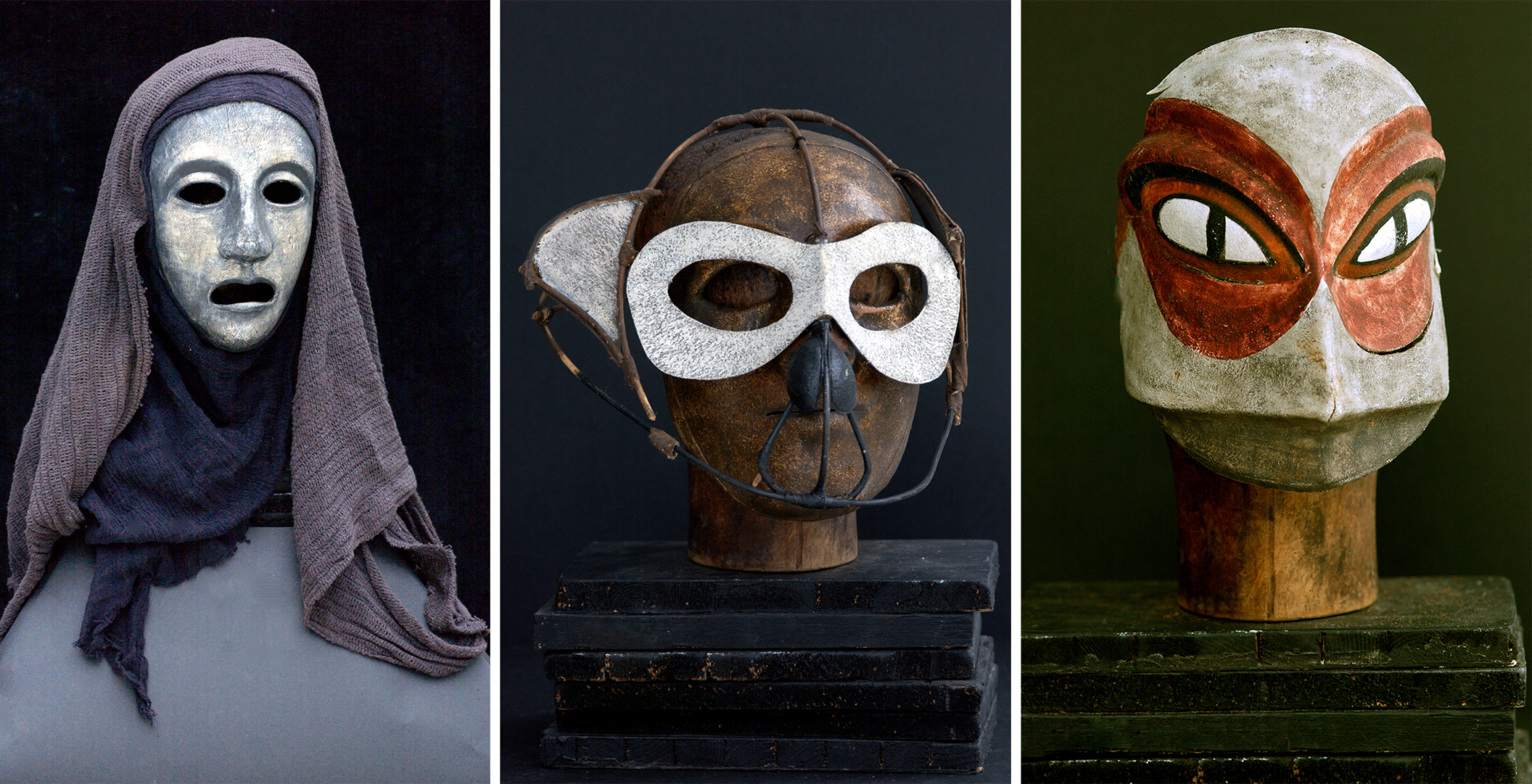

Since the beginnings of civilisation, humans have covered their faces. Across cultures, masks and goggles, hats and habits, veils and cowls all have varied roles to play, both functional and ritual: disguise, protection, decoration, comfort, concealment… They can be both practical garments and symbols of devotion – sometimes both simultaneously. More often than not, face coverings embody a duality of disguise and display: hiding one thing from the world, projecting another.
In many cases, face coverings represent thresholds and transitions between two states: actor to god on the stage, child to monster on Halloween, bride to wife in the church, citizen to criminal during the bank robbery. Masks are therefore a kind of liminal object, emblems of the in-between. In the age of Covid, as we put on our masks to go out and greet the world, they serve to highlight the nature of our relationships with those around us. Although they conceal much of our faces, they nevertheless make visible statements about our awareness of the consequences of individual behaviour on the wellbeing of the collective.
Now, as virtual-reality technology advances, we approach a critical juncture. Our physical and digital experiences are converging to the point where we must now consider our real-world needs while inhabiting the digital one. As access to the metaverse widens and it becomes more immersive, the more we need to consider our physical location, senses and ergonomics at those moments we are travelling within it.
While we access the digital world through sight (screen) and sound (audio) devices, we are always aware of our physical presence in space. As we transition into AR and VR, the contact between what we experience audio-visually and the rest of our senses begins to break down. The more we immerse ourselves bodily in the virtual world, the less invested we become in the expression of our physical selves in the real one.
The rise of digital worlds is beyond doubt. Inevitably, VR will almost certainly become more public, more social and more collective as its potential applications become clearer. As well as in the home, the metaverse in all its forms will appear in workplace, learning, leisure and sports settings.
Thus far, much of the focus has rightly been on the user’s experience within the virtual world. However, what we experience behind our VR goggles has a clear impact on our physical state. We have all seen the comedic visions of people swaying about, unstable and insecure, as they teeter on a cliff edge or race down a virtual ski slope. Right now, this sort of display can be regarded as innocent fun, but as VR use spreads, there is a risk that real-world self-consciousness will impede our willingness to fully engage with the sensory reality of the metaverse. The perception of how other people witness your own physical VR response on the ‘outside’ can dissuade use and thus limit the freedom that the virtual world can offer.
“…but as VR use spreads, there is a risk that real-world self-consciousness will impede our willingness to fully engage with the sensory reality of the metaverse.”
There are numerous solutions for the best distribution of technology hardware within physical space, but very rarely do we consider the physical and emotional impact of wearable tech, especially when we enter the world of virtual reality. To date, neither tech nor design has given much thought to this area, yet it seems obvious that there is a need for products that help VR users immerse more fully in the virtual, while retaining control of how they express themselves in the physical.
From fitness watches to smart jewellery, wearable tech has boomed in recent years. The distinct and often opposed cultures of fashion and technology have converged with results that are frequently fascinating, but rarely truly transformative in terms of the way we experience the world. VR offers a new – and potentially more impactful – arena for these two areas to collide.
Bulky and often destabilising, most current headset designs are derived from military use and express a masculine, almost prosthetic, language that reflects the technological heritage of the product – which stimulates awkwardness in some users. Surely there is scope for a more refined and appealing design language that can engage, reassure and even broaden the VR audience? Not simply in terms of
While we access the digital world through sight (screen) and sound (audio) devices, we are always aware of our physical presence in space. As we transition into AR and VR, the contact between what we experience audio-visually and the rest of our senses begins to break down. The more we immerse ourselves bodily in the virtual world, the less invested we become in the expression of our physical selves in the real one.


